
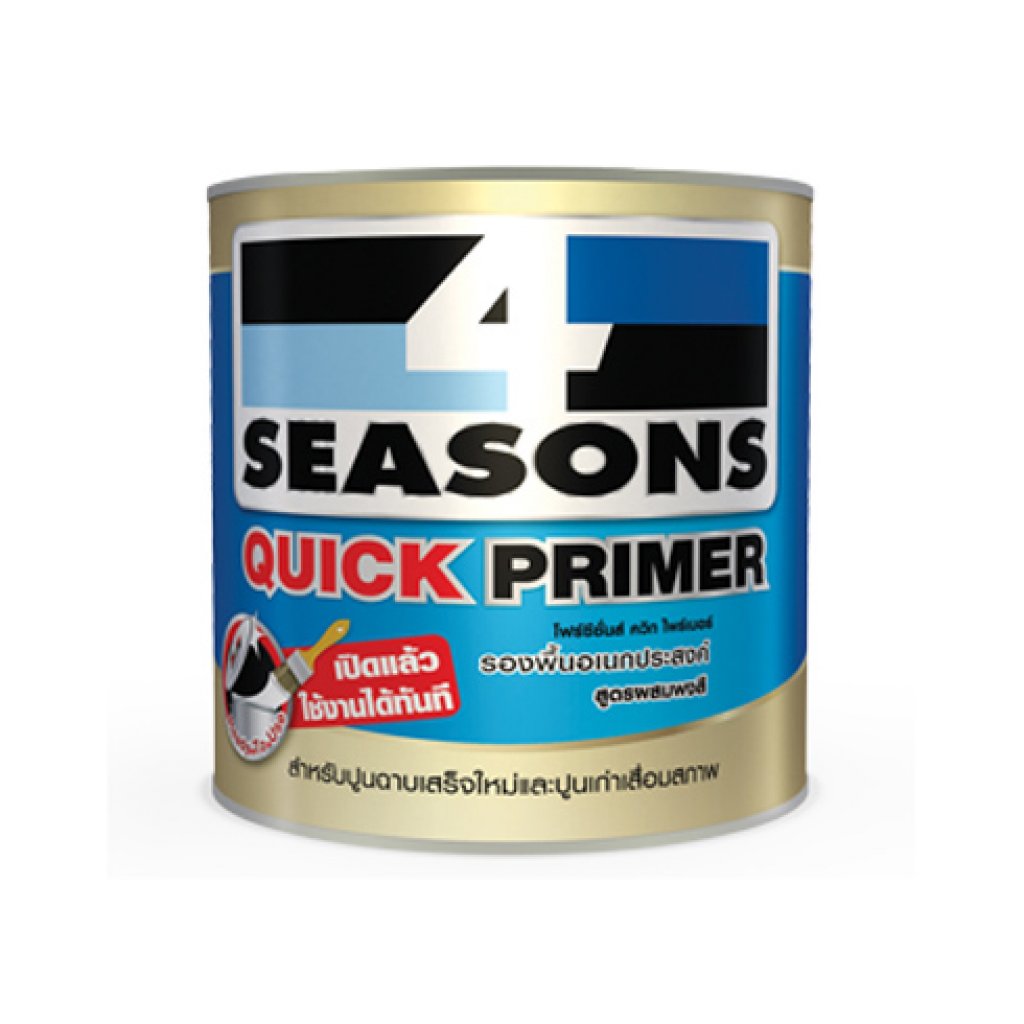
Toa 4 SEASONS Quick Primer
Toa 4 Seasons Quick Primer #1000 is a pigmented concrete primer for exterior and interior. Suitable for both fresh concrete and old concrete with high penetration and excellent adhesion. Ready to use and easy to apply, good coverage and good hiding, moisture resistance up to 40%. Can be apply even after plasting 2 days, excellent alkali resistance and anti-efflorescence, anti-fungus and algae. Environmentally friendly with no-added lead and mercury.
| Product Group | Medium |
| Type of Finishing | White-Matt |
| Can Size | 1 GL, 5 GL |
Multi purpose primer
- Suitable for both fresh concrete and old concrete.
- White color film, Good hiding.
- Moisture resistant up to 40%
- Excellent alkali resistance and anti efflorescense.
- Ready to use.
- No harm for healthy and environmental-friendly.
Use for fresh concrete and old concrete
Suitable for skimcoat substrate, fresh concrete, old concrete, brick, plaster, cement, fiber cement and gypsum.
APPLICATION SYSTEM
Surface Preparation
- New Surface
-
- Allow the surfaces dry at least 2 days in case of speedy work.
-
- The surfaces must be clean and free of dirt, grease, oil, wax, salt and other contaminants.
-
- Toa 301 Acrylic Sealent or TOA Acrylic Filler is used to repair all cracks and rough surfaces.
- Old surface
- The surfaces must be clean and free of dirt,wax,salt,old paint and other contaminants.
-
- Chalky surfaces or loose material must be removed by stiff brush.
-
- Toa 113 Microkill is used to get rid of algae and fungi that left on the surfaces.
-
- The surfaces must be clean with suitable cleansing solution and water then rinse thoroughly with fresh water and allow to fully dry.
-
- Toa 301 Acrylic Sealent or TOA Acrylic Filler is used to repair all cracks and rough surfaces.
Coating system
- Primer
-
- Apply by brush with 4Seasons Quick Primer 1 coat.
- Topcoat
- Can be topcoat with Acrylic Emulsion Paint and Alkyd Base Enamel Paint.
Recommendation
- The temperature of the substrate should be minimum 10 ํC and at least 3 ํC above the dew point of the air, ํ temperature and relative humidity measured in the vicinity of the substrate. Good ventilation is required in confined areas to ensure correct drying.